
Economy Builder Partner Stories:
Joe Stefko and OneROC
Investing in Places, Strengthening Communities
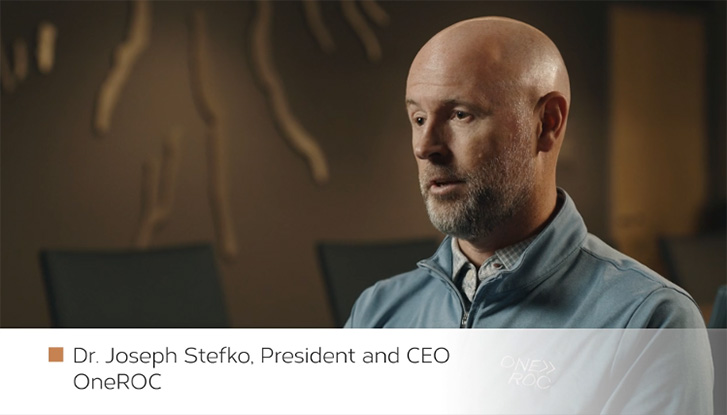
Joe Stefko doesn’t talk about Rochester as a case study. He talks about it as home.
“I get really excited about this work because this place matters to me,” he says. “I live here. I raise my family here. I want this region to be stronger ten, twenty years from now.”
That personal stake shapes how Stefko approaches his role as President and CEO of OneROC, the regional economic alliance serving the nine-county Greater Rochester region.
Connecting Economic Development to Work as One
Founded in 2019, OneROC was created to do something Rochester had struggled with for years: coordinate its economic development efforts around a shared strategy, rather than a collection of well-intentioned but disconnected initiatives.
From the beginning, the goal was capacity. OneROC builds the systems that make regions competitive over the long term: business growth and attraction, talent development and retention, downtown revitalization, and regional branding.
The work is deliberately broad because, as Stefko sees it, economic strength doesn’t come from a single project or sector. “It’s all connected,” he says. “If you want investment, you need talent. If you want talent, you need places people want to live. If you want strong neighborhoods, you need thriving small businesses.”
The Opportunity of the Regional Revitalization Partnership
As a regional economic alliance, OneROC operates as a convener and catalyst, aligning public, private, and philanthropic investments that might otherwise happen in silos. Over time, that role has expanded beyond coordination into direct leadership on several major regional initiatives.
One of those is the Regional Revitalization Partnership (RRP), a tri-city effort spanning Rochester, Buffalo, and Niagara Falls. Through RRP, OneROC serves as the Rochester intermediary, translating regional strategy into local action.
“What makes RRP different is the co-investment model,” Stefko explains. “Private sector, public sector, philanthropy are all investing together around a shared vision.”
In Rochester, that vision focuses on three priorities: commercial corridor revitalization, placemaking with an emphasis on the Genesee Riverfront, and small business and workforce supports. To date, roughly $35 million in RRP investments have moved forward across the city.
From Stagnation to Momentum
One of the most visible examples is Harper’s Corner, a long-stalled property at the intersection of Main and Clinton in downtown Rochester. For years, the site symbolized a missed opportunity. Today, it stands as a living example of what coordinated investment can unlock.
“That project became emblematic of what was possible when partners aligned,” Stefko says. “It’s about restoring confidence in the heart of downtown.”
RRP investments also reach the neighborhood level, such as through the Greenwood Project in Rochester’s EMMA and Beechwood areas. OneROC supports Connected Communities, the organizations behind the Neighborhood Hub and Connect Lab, two community-centered spaces designed to foster local entrepreneurship, creativity, and connection.
“These projects matter because they’re rooted in the neighborhood,” Stefko explains. “They allow residents and entrepreneurs to see themselves as part of the economic fabric, not as an afterthought.”
Why the Intermediary Role Matters
Serving as the local intermediary for RRP allows OneROC to do what it does best: align stakeholders and build strong capital stacks. Many RRP funders already sit at OneROC’s coordinated table, enabling investments that are larger and more strategic than isolated grants.
“OneROC brings deep knowledge of Rochester’s neighborhoods and players,” Stefko says. “That local insight makes the regional strategy real.”
A key partner in that work is the Center for Regional Strategies, which Stefko describes as a critical thought partner across the RRP. “They bring data, analysis, and institutional knowledge,” he says. “But just as important, they’ve created a community of practice across Rochester, Buffalo, and Niagara Falls.”
That cross-region learning is one of RRP’s quiet strengths. Each city moves faster by sharing what works and what doesn’t.
Building Toward Long-Term Vitality
For Stefko, the ultimate measure of success isn’t ribbon cuttings. It’s whether investments today lead to healthier households, stronger neighborhoods, and a more resilient regional economy.
“Healthy households lead to healthy neighborhoods,” he says. “And that’s how you build a competitive region.”
By strengthening commercial corridors, supporting small businesses, and creating places where people can live, work, and innovate, Stefko believes RRP investments are laying the foundation for long-term growth, down to the household level.